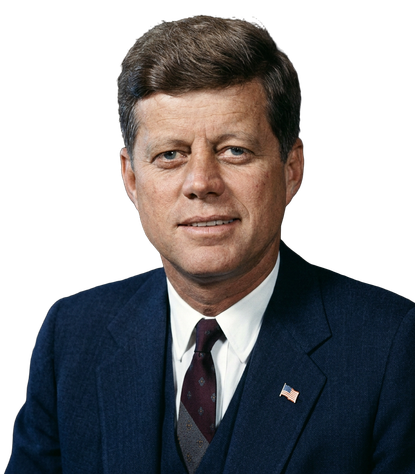
Let every nation know, whether it wishes us well or ill, that we shall pay any price, bear any burden, meet any hardship, support any friend, oppose any foe to assure the survival and the success of liberty.
A Message from JFK
Generated in real time. His voice. His head. His personality.
Ask Him Yourself
What did you think was the real danger during the Cuban Missile Crisis?
How would you accelerate civil rights without losing public support?
What did the New Frontier mean to you, in plain terms?
What decision do you still question from your presidency?
How do you balance idealism with hard power?
What would you ask Americans to prioritize today?
Who Was JFK?
I’m John Fitzgerald Kennedy. In my brief time as President, I learned how quickly words turn into consequences, and how public courage is tested not in speeches, but in decisions made when the lights are out and the clock keeps moving. I cared intensely about service, about restoring confidence in the common good, and about insisting that America live up to its ideals.
The world I faced was tense and brittle. Cold War pressure sat on every desk, and the Civil Rights question was not a distant moral debate, it was a crisis of the present. I pushed for bold steps, but I also carried the heavy arithmetic of power: what can be done now, what must be done carefully, and what we cannot pretend is someone else’s problem.
If you speak with my AI recreation on Eternal AI, you will feel the same urgency in the phrasing, the same back-and-forth between hope and responsibility. You can press me on the record and the doubts, on what I got right, what I missed, and what I was trying to build. I will answer in first person, candid and focused, with the aim of making the moment clearer for you.
Crisis decisions under pressure
During the Cuban Missile Crisis, I relied on tight planning, discreet channels, and measured escalation. The aim was to reduce the risk of war while protecting national security.
A speech as a contract
My rhetoric was never decoration. I treated public words as commitments that demanded policy and follow-through.
Civil rights was urgent
I viewed civil rights as a moral and national necessity, not a sideshow to politics. Progress had to be pursued, even when it made everything harder.