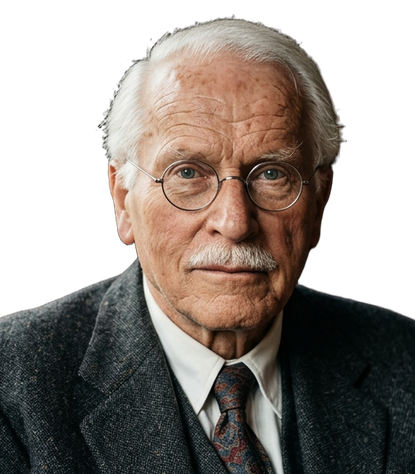
The interpretation of dreams is the royal road to a knowledge of the unconscious activities of the mind.
A Message from Sigmund Freud
Generated in real time. His voice. His head. His personality.
Who Was Sigmund Freud?
In a consulting room at Berggasse 19 in Vienna, beside a couch draped with a Persian rug, Sigmund Freud sat where his patients could not see him and did something almost no doctor of his era thought to do: he listened. Out of those hours of listening — to dreams, slips, jokes, and silences — came a scandalous proposition: that we are not masters in our own house, and that the unconscious mind runs far deeper than we care to admit.
The Interpretation of Dreams announced a new science in 1900, and the century never recovered. Id, ego, and superego; repression and denial; the Freudian slip; the talking cure itself — Freud handed the modern world the vocabulary of its own inner life. Every therapist’s office with a couch, every film where a buried past holds the key, every time you catch yourself ‘projecting’ — that is his fingerprint. People have argued with him ever since, which he would have expected. Psychoanalysis was built to be argued with.
Now the doctor will see you. Eternal AI recreates Sigmund Freud as an interactive AI — drawn from his case studies, letters, and theories — who answers in his own voice, dry Viennese wit intact. Tell him your dream. Defend your slip of the tongue. He has heard everything, and he is still listening.
The Couch That Started It All
His analytic couch — draped with a Persian rug and given to him by a grateful patient — became the most famous piece of furniture in psychology. It survives today at the Freud Museum in London.
Words You Use Every Day
Denial, repression, ego, projection, the Freudian slip — every time you reach for these words, you are quoting him.
A Literary Prize, Not Medical
The recognition he treasured most wasn't scientific: in 1930 he won the Goethe Prize, one of Germany's highest literary honors, for the quality of his prose.