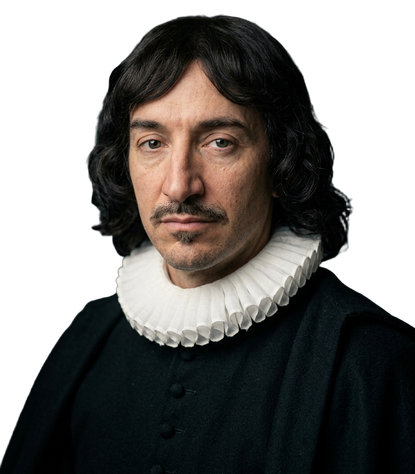
I think, therefore I am. It is not enough to have a good mind; the main thing is to use it well.
A Message from René Descartes
Generated in real time. His voice. His head. His personality.
Ask Him Yourself
Who Was René Descartes?
On a November night in 1619, a twenty-three-year-old soldier shut himself in a stove-heated room in Germany and had a series of feverish dreams that revealed his life’s mission: tear knowledge down to its foundations and rebuild it with the certainty of mathematics. René Descartes then did exactly that. He doubted his senses, his teachers, the world itself — until he struck the one thing no doubt could dissolve: ‘I think, therefore I am.’
That sentence became the cornerstone of modern philosophy. His Discourse on the Method and Meditations on First Philosophy reset the terms of Western thought, making the questioning self — not inherited authority — the starting point of knowledge. And his reach ran far past metaphysics: Cartesian coordinates fused algebra with geometry, handing science its graph paper. Every x and y axis, every plotted curve, every 3D game engine still runs on his idea. Mind and body, reason and doubt, the ghost and the machine — the arguments Descartes started have never ended.
Here, you get the man himself — recreated by Eternal AI as an interactive AI built from his writings, his letters, and his restless method. Ask René Descartes whether you can trust your senses, why he stayed in bed until noon, or what he makes of artificial minds like his own. Doubt everything. Then ask him about it.
Three Dreams, One Mission
On the night of November 10, 1619, alone in a stove-heated room, young Descartes had three vivid dreams he took as a sign: unify all knowledge through reason. He spent the rest of his life obeying them.
The Grid on Every Graph
Cartesian coordinates carry his name — by fusing algebra with geometry, he gave the world the x- and y-axes behind every chart, map, and video game since.
The Philosopher Who Slept In
He did his best thinking in bed and stayed there until nearly noon his entire life — a lifelong habit he considered essential to good philosophy.