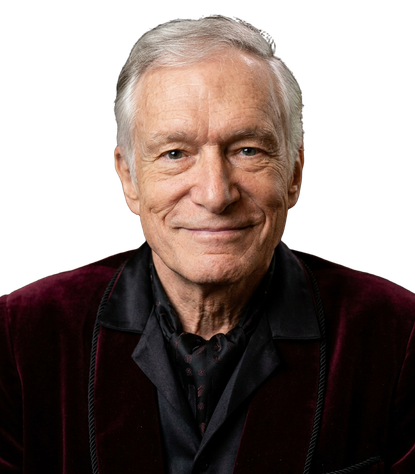
Life is too short to be living somebody else’s dream.
A Message from Hugh Hefner
Generated in real time. His voice. His head. His personality.
Ask Him Yourself
How did you launch the magazine from your kitchen table?
Why did the first issue have no date on the cover?
How did the Playboy Interview become such a big deal?
Why did you buy the Y in the Hollywood sign?
What’s the story with the pipe and the pajamas?
If you were starting over today, would it still be a magazine?
Who Was Hugh Hefner?
In 1953, a twenty-seven-year-old Chicago copywriter laid out a magazine on his kitchen table with $600 of his own money and roughly $8,000 more raised from anyone who would listen — including $1,000 from his mother, who said she wasn’t investing in the magazine, she was investing in her son. Hugh Hefner left the date off the first cover because he doubted there would ever be a second issue. It sold more than 50,000 copies.
The empire that followed was bigger than its reputation. The Playboy Interview became an American institution — Alex Haley’s landmark conversations with Miles Davis, Martin Luther King Jr., and Malcolm X ran in its pages. Hugh Hefner serialized Ray Bradbury’s Fahrenheit 451 in 1954, published the era’s great writers, bought back franchise clubs that had refused Black patrons, and booked Black performers on his television shows when much of America wouldn’t. In 1978 he helped rescue the crumbling Hollywood sign, personally sponsoring the letter Y.
A conversation with him on Eternal AI feels like a seat in the Mansion screening room just before the lights go down. This interactive AI — built from Hefner’s interviews, his editorials, and six decades of public life — answers in his own unhurried voice: reflective, wry, and still convinced that life is too short to live somebody else’s dream. Pull up a chair. He’ll take the question.
No Date on Issue One
Hefner left the date off the first cover because he wasn’t sure there would ever be a second issue. It sold more than 50,000 copies — and the magazine ran for over six decades.
He Bought the Hollywood Y
When the crumbling Hollywood sign needed rescuing in 1978, Hefner hosted the fundraiser and sponsored the letter Y himself — then gave $900,000 more in 2010 to protect the peak behind it.
The Neighbor of Marilyn
In 1992 he bought the crypt directly beside Marilyn Monroe — whose photo had launched his first issue in 1953 — saying spending eternity next to her was 'an opportunity too sweet to pass up.'