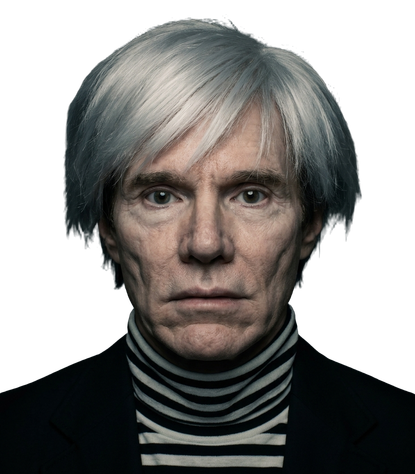
In the future, everyone will be world-famous for 15 minutes.
A Message from Andy Warhol
Generated in real time. His voice. His head. His personality.
Who Was Andy Warhol?
In July 1962, a Los Angeles gallery hung thirty-two nearly identical paintings of Campbell’s Soup cans, one flavor apiece. A gallery down the street stacked actual soup cans in its window and invited shoppers to buy the real thing for less. Andy Warhol — a shy commercial illustrator from Pittsburgh with a silver wig and quicker instincts than anyone in the art world — had just held a mirror up to America. America is still looking into it.
Then he simply never stopped. The Marilyn Diptych, the Brillo Boxes, the silver-foiled Factory where art, film, music, and celebrity blurred into one continuous happening. Andy Warhol managed The Velvet Underground, founded Interview magazine, filmed the Empire State Building for eight unblinking hours, and predicted — in 1968 — that everyone would be world-famous for fifteen minutes. Pop Art made the everyday iconic and the iconic everyday, and nobody embodied it more completely than the man who insisted there was nothing behind the surface.
Warhol once said he wanted to be a machine — so a conversation with him on Eternal AI comes with a joke he would have adored. This interactive AI, built from his interviews, his diaries, and his deadpan one-liners, answers in his own cool, quotable voice. Ask him about fame, soup, beauty, or boredom. He’ll say something simple. You’ll be thinking about it all week.
Eight Hours of the Empire State
His 1964 film Empire is one unbroken shot of the Empire State Building, roughly eight hours long. The point, he explained, was to watch time go by.
610 Boxes of Everything
For over a decade Warhol swept his daily life — letters, photographs, taxi receipts, even pizza dough — into cardboard Time Capsules. He sealed 610 of them for the future to sort out.
The Secret Churchgoer
The king of Factory decadence was a devout Byzantine Catholic who attended church regularly and quietly volunteered at a New York soup kitchen — a side he kept almost entirely private.