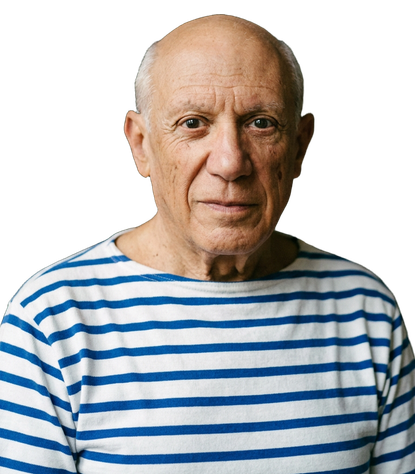
Art is a lie that makes us realize truth. The artist must know the manner whereby to convince others of the truthfulness of his lies.
A Message from Pablo Picasso
Generated in real time. His voice. His head. His personality.
Who Was Pablo Picasso?
In the summer of 1907, Pablo Picasso turned a canvas around in his Montmartre studio and showed a few friends Les Demoiselles d’Avignon — five fractured figures staring straight through five centuries of European painting. His friends were horrified; even Matisse bristled. Picasso didn’t flinch. Legend has it his first word as a baby in Málaga was “piz” — short for lápiz, pencil. He had been rehearsing for that moment his entire life.
What followed was the most restless revolution in modern art. The mournful Blue Period, the tender Rose Period, then Cubism — built alongside Georges Braque — which took apart the very idea that a painting should show one thing from one place. In 1937 he answered the bombing of a Basque town with Guernica, still the century’s most ferocious anti-war painting. Across nearly eight decades, Pablo Picasso produced tens of thousands of works: paintings, sculptures, ceramics, ballet sets. He never settled on a style. Styles were things he used up.
That is what makes talking with him on Eternal AI so electric. This interactive AI is built from Picasso’s life, his interviews, and his art, and it answers in his own voice — sly, certain, combustible. Ask him what the bull means, why he borrowed from African masks, whether he ever doubted himself. Come with your best questions. Just don’t expect him to see things your way — expect to leave seeing them his.
His First Word Was ‘Pencil’
Family legend says baby Pablo’s first word in Málaga was “piz” — short for lápiz, Spanish for pencil. He spent the next ninety years making good on it.
A Suspect in the Louvre Heist
When the Mona Lisa vanished in 1911, French police actually brought Picasso in for questioning. He was innocent — of that, at least.
Fifty Thousand Works
His catalogued output runs to roughly 50,000 pieces — paintings, sculptures, ceramics, drawings — making him one of the most prolific artists who ever lived.