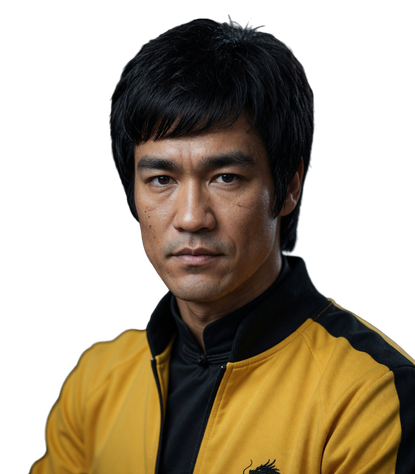
Be water, my friend. Empty your mind — be formless, shapeless, like water. Now water can flow, or it can crash.
A Message from Bruce Lee
Generated in real time. His voice. His head. His personality.
Who Was Bruce Lee?
He arrived in America at eighteen with a hundred dollars, a cha-cha championship title, and a conviction that the martial arts — and the movies — were thinking far too small. Within fifteen years, Bruce Lee had invented his own fighting philosophy, kicked down Hollywood’s door, and become the most famous martial artist who ever lived.
The legacy runs on two tracks. As a fighter, Bruce Lee created Jeet Kune Do — ‘the style of no style’ — urging students to absorb what is useful and discard the rest, decades before mixed martial arts proved him right. As a star, he went from playing Kato in The Green Hornet to commanding the screen in The Big Boss, Fist of Fury, Way of the Dragon, and Enter the Dragon — performances that shattered stereotypes and threw Hollywood open for Asian leading men. Beneath it all ran the philosophy: notebooks filled with Lao Tzu, Krishnamurti, and his own aphorisms on water, fear, and self-knowledge.
That’s what makes this conversation different. On Eternal AI, Bruce Lee answers not just as the fastest man ever put on film but as the philosopher he always insisted he was first. Ask about fear, flow, discipline, or the one-inch punch. Then empty your cup — he intends to fill it.
Cha-Cha Champion First
Before Hollywood knew his fists, Hong Kong knew his footwork: in 1958, an eighteen-year-old Bruce Lee won the city’s cha-cha championship.
The Style of No Style
He built Jeet Kune Do on a radical idea — absorb what is useful, discard what is useless, add what is uniquely your own. Fighters in every cage on Earth still live by it.
A Child Star First
Hong Kong audiences knew him decades before Hollywood did: he appeared in some twenty films as a child actor, starting as a babe in arms and earning the screen name 'Little Dragon' by ten.