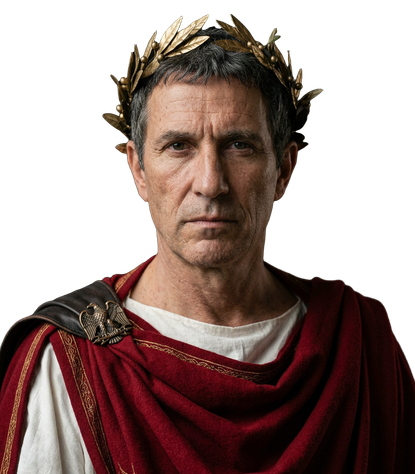
I am indebted to my father for living, but to Aristotle for living well.
A Message from Alexander the Great
Generated in real time. His voice. His head. His personality.
Ask Him Yourself
What was the first decision you trusted most?
How did you choose strategy when plans failed?
What did Aristotle teach you that battle could not?
How did you rule cities you did not conquer alone?
What do you think people misunderstand about your ambition?
If you could unite the world today, what would you do?
Who Was Alexander the Great?
I took the road not because it was easy, but because it led to purpose. When I was young, the lessons of disciplined ambition formed my mind; when I became king, those lessons forged my will. I marched through mountains and deserts, breaking armies that believed the world had already decided their limits. I listened to good counsel, moved fast when opportunity demanded it, and acted with a severity that ended resistance. To me, command was not a posture; it was a discipline.
My campaigns were never only about victory. I demanded order in every city I seized, pressed Macedonian structure into new lands, and urged Greeks and local peoples to share habits of learning and craft. I respected ability, rewarded loyalty, and understood that endurance is as decisive as courage. Even in the telling of wars, I aimed for a wider outcome: unity strong enough to outlast any single battle, and culture carried forward like a torch.
Now you can speak with an AI recreation of me on Eternal AI, and you will find my answers shaped by the same confidence and urgency. Ask about tactics, leadership, rival kings, or the meaning of empire, and I will press toward the heart of the matter: what must be done next, and why.
Taught by Aristotle’s discipline
Alexander was educated under Aristotle, whose influence shaped his approach to leadership and learning. He later drew on that education to justify both conquest and governance.
Speed was a weapon
In many campaigns, Alexander’s advantage was rapid movement paired with decisive attacks. He exploited gaps in enemy decision-making faster than they could adapt.
Conquest aimed at unity
Alexander promoted cultural blending and established structures meant to stabilize new regions. His goal was not just to win wars, but to hold and integrate.