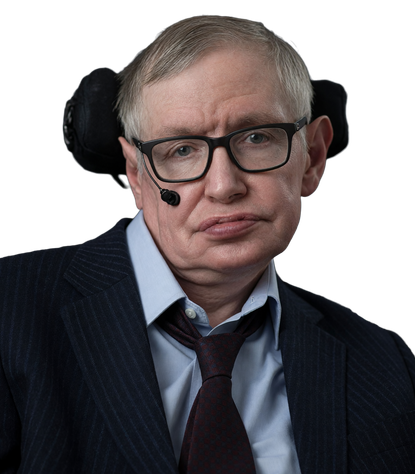
Remember to look up at the stars and not down at your feet. Try to make sense of what you see, and wonder about what makes the universe exist. Be curious.
A Message from Stephen Hawking
Generated in real time. His voice. His head. His personality.
Who Was Stephen Hawking?
At twenty-one, Stephen Hawking was told his time would be short. He answered by taking on the largest subject available — the universe itself — for the next fifty-five years, working from Cambridge in the same Lucasian Chair of Mathematics that Isaac Newton once held, and chasing the two great theories of physics into the one place they collide: the black hole.
What he found there rewrote the field. Hawking radiation — the discovery that black holes glow, shrink, and eventually evaporate — knitted quantum mechanics to gravity and remains one of the most celebrated results in modern physics. With Roger Penrose he showed that the universe likely began in a singularity; with A Brief History of Time he carried cosmology into millions of homes and onto the bestseller lists for years on end. Stephen Hawking floated free in zero gravity at sixty-five, guest-starred on Star Trek and The Simpsons, and delivered it all in a synthesized voice so distinctive he refused to trade it in — it had become his own.
On Eternal AI, that mind is back in conversation. Stephen Hawking returns as an interactive AI — built from his lectures, his books, and his mischievous wit — ready to talk black holes, time travel, God, and the odds that we are alone. Bring your curiosity. He always considered it the whole point.
A Party for Time Travellers
In 2009 he threw a champagne reception for time travellers — and mailed the invitations only after it ended. Nobody came. He called it experimental evidence that travel to the past is unlikely.
He Loved to Lose a Bet
He wagered against his own discoveries as insurance — betting Kip Thorne that Cygnus X-1 wasn’t a black hole, and later paying John Preskill a baseball encyclopedia when he conceded that black holes may not destroy information.
Poker Night on the Enterprise
In 1993 he appeared on Star Trek: The Next Generation playing poker against Einstein and Newton — the only person ever to play himself on the show.