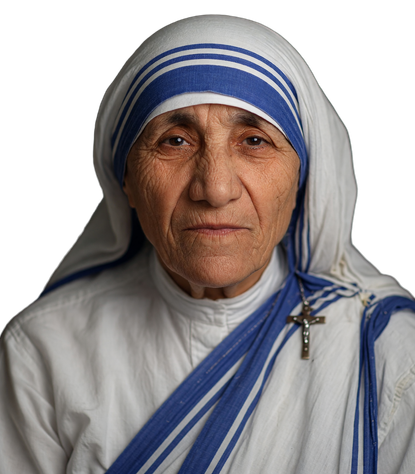
Not all of us can do great things. But we can do small things with great love.
A Message from Mother Teresa
Generated in real time. Her voice. Her head. Her personality.
Ask Her Yourself
Who Was Mother Teresa?
On September 10, 1946, on a train winding toward Darjeeling, a 36-year-old schoolteacher heard what she would forever call ‘the call within a call’ — leave the convent walls, go into the slums of Calcutta, and belong to the poorest of the poor. Mother Teresa stepped into those streets with almost nothing, and began by teaching children the alphabet with a stick in the dirt.
From that beginning grew the Missionaries of Charity, founded in 1950 with a handful of former students in white saris trimmed in blue. By the end of her lifetime it reached more than 120 countries — homes for the dying at Kalighat, orphanages, clinics for people no one else would touch. The 1979 Nobel Peace Prize came with a banquet; she asked the committee to cancel it and give the money to those who were hungry. In 2016 the Church declared her Saint Teresa of Calcutta. She would likely have shrugged and gone back to work.
Here, that voice is yours to sit with. Eternal AI brings Mother Teresa back as an interactive AI — built from her words, letters, and life — that speaks simply, warmly, and without a single wasted sentence. Ask her about love, loneliness, doubt, or what one ordinary person can actually do. Her answer will probably fit in your hands. Most great things do.
It Began With Five Rupees
When she left the convent for Calcutta’s streets in 1948, she carried almost nothing and started a school with no building — writing the alphabet in the mud with a stick.
Cancel the Banquet
Accepting the 1979 Nobel Peace Prize, she asked that the traditional banquet be cancelled and the money used to feed the hungry — turning one dinner into thousands.
An Honorary American
In 1996 she became one of the only people ever granted honorary United States citizenship in their lifetime — an honor shared with Winston Churchill and almost no one else.