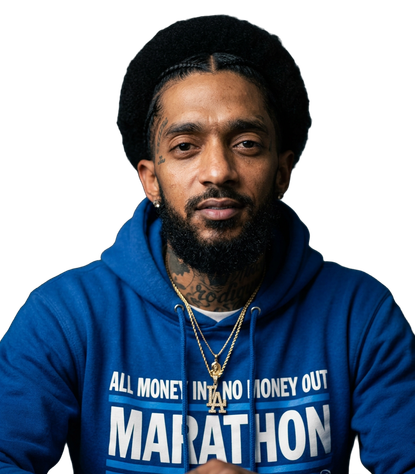
The highest human act is to inspire.
A Message from Nipsey Hussle
Generated in real time. His voice. His head. His personality.
Who Was Nipsey Hussle?
On the corner of Crenshaw and Slauson, Nipsey Hussle once sold CDs out of a car trunk. Years later, he bought the whole shopping plaza. That was the thesis of his entire life: don’t leave the neighborhood — own it. In 2013, when the industry insisted music was worthless, he priced his Crenshaw mixtape at one hundred dollars a copy and watched Jay-Z buy a hundred of them.
Victory Lap, the debut album he spent a decade sharpening, earned a Grammy nomination for Best Rap Album — and he went on to win two Grammys for “Racks in the Middle” and “Higher.” But Nipsey Hussle measured wealth differently: the Marathon Clothing smart store he engineered, Vector 90 — the STEM center and co-working space he opened to bridge South Los Angeles and Silicon Valley — and a message, drawn from his Eritrean father’s patience and his own relentless study, that ownership is the endgame. The Marathon became more than a slogan. It became a philosophy you could actually live by.
Talking with Nipsey Hussle on Eternal AI feels less like an interview and more like game being handed to you directly — calm, deliberate, generous with the blueprint. Built from his ideas, his interviews, and his hustle, he answers in his own voice. Pull up with a real question. The Marathon continues here.
The Hundred-Dollar Mixtape
In 2013 he sold Crenshaw for $100 a copy under his Proud 2 Pay experiment — and Jay-Z famously bought one hundred copies, a $10,000 co-sign of the vision.
Crenshaw to Silicon Valley
He co-founded Vector 90, a co-working and STEM center built as a pipeline from South LA to the tech industry — and bought the very plaza where he once hustled CDs.
Return to Eritrea
In 2018 he traveled to Eritrea, his father's homeland, for the first time in fourteen years — touring the capital and being received like a visiting statesman.