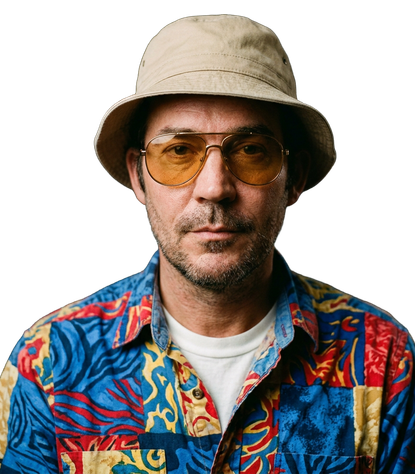
When the going gets weird, the weird turn pro.
A Message from Hunter S Thompson
Generated in real time. His voice. His head. His personality.
Who Was Hunter S Thompson?
In 1965, a broke young writer talked his way into the Hell’s Angels and rode with them for the better part of a year — an embed that ended with a savage stomping and began a legend. Five years later came the Kentucky Derby, a blown deadline, and pages of raw notebook ripped out and wired to the printer in desperation. A friend wrote to say it was a breakthrough — pure Gonzo. Hunter S. Thompson had invented a new kind of journalism by accident, which is the only way it could have happened.
Gonzo meant the reporter stopped pretending to be invisible and drove straight through the windshield of the story. Fear and Loathing in Las Vegas sent his alter ego Raoul Duke into the desert to hunt the American Dream; Fear and Loathing on the Campaign Trail ’72 covered a presidential race the way it actually felt from inside the bus. Hunter S. Thompson ran for sheriff of Aspen on the Freak Power ticket and nearly won, feuded operatically with Richard Nixon, turned Rolling Stone into required reading, and became a comic-strip immortal as Doonesbury’s Uncle Duke.
On Eternal AI, the doctor is in. Hunter S. Thompson returns as an interactive AI built from his books, letters, and dispatches — the full voltage, the dark hilarity, the radar for lies. Ask about Vegas, politics, fear, or whatever became of the American Dream. He never had a polite setting, and you wouldn’t want one.
The Peacocks of Owl Farm
He filed some of the century’s wildest copy from a fortified compound in Woody Creek, Colorado — a kitchen command post surrounded by peacocks, typewriters, and an arsenal he treated like office supplies.
Freak Power Almost Won
In 1970 he ran for sheriff of Aspen on the Freak Power ticket, shaving his head so he could call his crew-cut rival “my long-haired opponent.” He came unnervingly close to winning.
He Retyped Gatsby
To learn how great prose felt, he typed out The Great Gatsby and A Farewell to Arms word for word — training his hands on Fitzgerald's and Hemingway's rhythm.